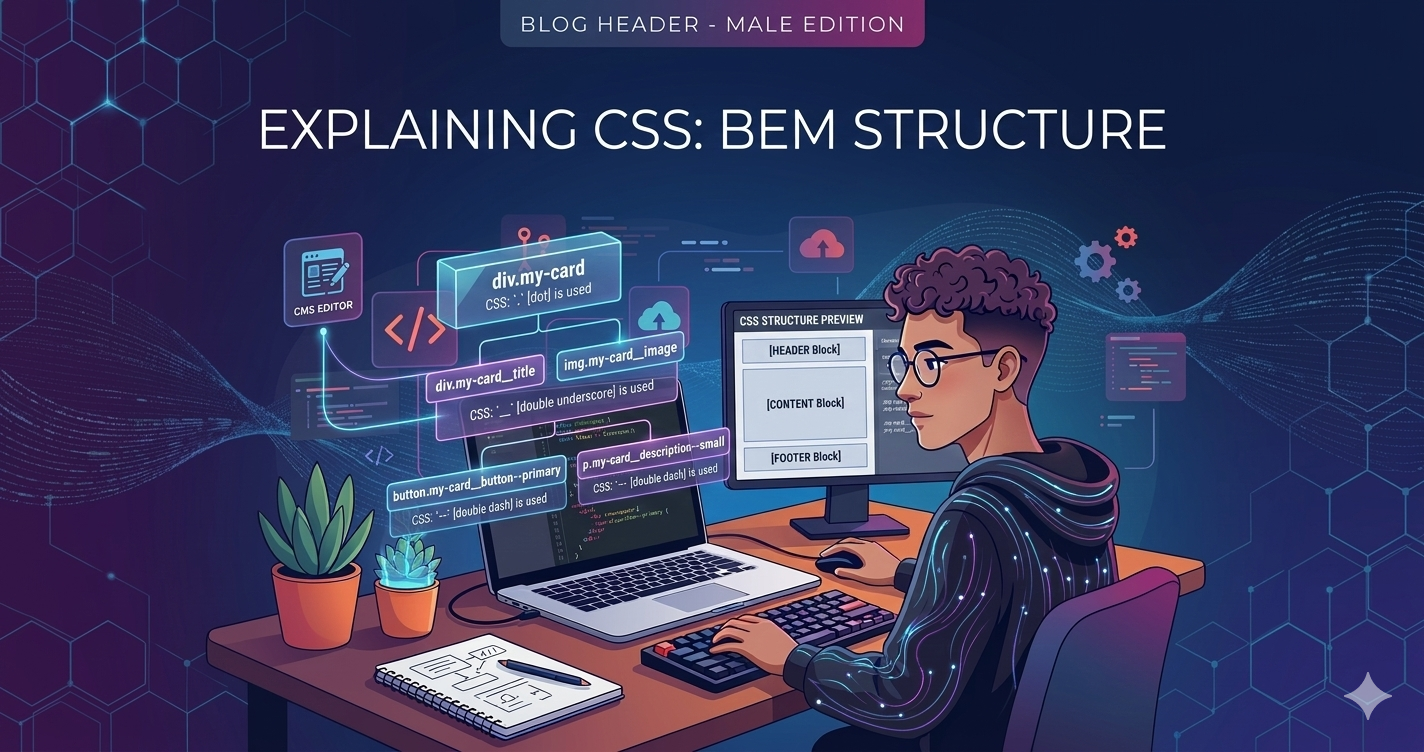
In modern frontend development, writing scalable and maintainable CSS is one of the biggest challenges developers face. As projects grow, styles often become messy, difficult to debug, and prone to conflicts.
This is where BEM (Block, Element, Modifier) comes in — a powerful CSS methodology designed to create clean, reusable, and structured code.
1. What is BEM?
BEM stands for:
It is a naming convention that helps developers organize CSS into reusable components. The main idea is to structure your UI into independent blocks and clearly define their parts and variations.
2. Why Use BEM?
Before jumping into syntax, let’s understand why BEM is widely used:
✔ Better Code Organization
BEM structures your CSS around components, making it easier to navigate and maintain large codebases.
✔ No Specificity Conflicts
Since BEM relies mostly on single class selectors, it avoids CSS conflicts and overrides.
✔ Reusable Components
Each block is independent, allowing you to reuse components across projects.
✔ Easier Team Collaboration
Developers can quickly understand code just by reading class names.
3. Core Concepts of BEM
A Modifier defines variations or states of a block or element.
block--modifier
block__element--modifier
4. BEM Naming Convention
block
block__element
block--modifier
block__element--modifier
This naming makes your code:
- self-explanatory
- easy to debug
- conflict-free
5. Step-by-Step Implementation
Let’s build a simple UI component using BEM.
Step 1: Identify the Block
Step 2: Add Elements
Step 3: Add Modifiers
6. Best Practices
✔ Use class selectors only (avoid IDs and tags)
✔ Keep blocks independent
✔ Avoid deep nesting
✔ Use meaningful names
✔ Reuse components whenever possible
7. Common Mistakes to Avoid
❌ Overly long class names
❌ Nesting too many elements
❌ Mixing block logic with element styles
❌ Not following consistent naming
8. When Should You Use BEM?
BEM is especially useful when:
- You are working on large projects
- Multiple developers are involved
- You want scalable CSS architecture
- You are not using scoped CSS (like CSS Modules or Tailwind)
9. Final Thoughts
BEM is not just a naming convention — it’s a mindset for writing better CSS.
By structuring your code into blocks, elements, and modifiers, you create a system that is:
- scalable
- maintainable
- easy to understand
Whether you're building a simple landing page or a large web application, adopting BEM can significantly improve your frontend workflow.